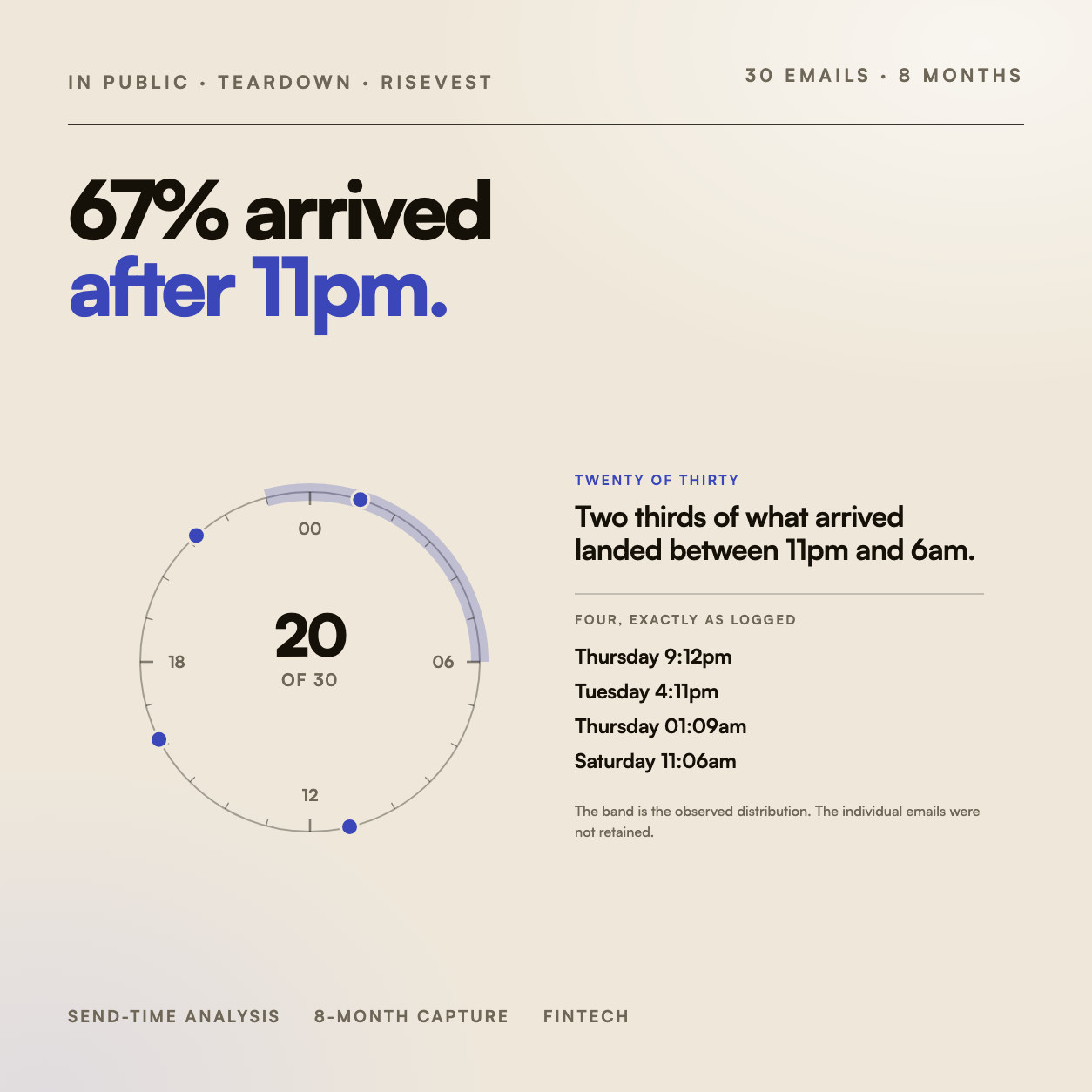
67% arrived after 11pm.
I stayed subscribed to Risevest for eight months and logged when all thirty emails arrived.
Most lifecycle teardowns are a snapshot: sign up, screenshot the first few emails, draw conclusions. That catches the welcome sequence and nothing else — and the welcome sequence is the part every company has already polished.
Eight months subscribed. Thirty emails. I logged when each one arrived.
Twenty of the thirty arrived after 11pm. Some at 1am. Some at 2am.
- Thursday 9:12pm
- Tuesday 4:11pm
- Thursday 01:09am
- Saturday 11:06am
CalculatedFrom the 30-email capture. A reconstruction of the observed distribution — not thirty screenshots. The individual captures were not retained.
MailerLite’s analysis of 3.6 million campaigns puts peak engagement at 6–8am, second at 12–2pm, and the lowest band at 10pm–6am.
Two thirds of what I received landed in that last band.
SourceMailerLite analysis of 3.6M campaigns, 2025
Inconsistent timing makes it harder to establish a predictable communication rhythm.
EstimateThat’s a lifecycle principle, not a measured outcome of this study.
Where I’d start looking.
None of these is established for Risevest. They’re where I’d start.
Many tools send in UTC unless the timezone is set.
Someone queues it when it’s ready; nobody checks when it lands.
If open rate isn’t cut by send time, nobody finds out.
HypothesisNot established for Risevest.
Thirty emails. Eight months. One pattern worth investigating: most of them arrived after 11pm.
What that costs in attention is a question for the data. I only have the timestamps.